More Testing Does Not Produce Smarter Kids

IMG_20180912_151757

I’m lying in bed reading my favorite romance novel – I could lie and say Romeo and Juliet, but too many people know what I read and would start to laugh – and take a break to do some Facebooking.

What pops up is the news that the State of Confusion (a state I previously taught in, that I won’t name) is introducing a new test to replace the current national test they are using –  PARCC – which I believe stands for Performance Anxiety Required for all Children Consistently.  While PARCC desperately needs replacing, it is the worst test I saw in over three decades of teaching, I am not optimistic that the State of Confusion will do better with the next replacement test.

Let me do a little mental review.  I am trying to remember what tests we were using when I began my teaching career.  I was teaching in a multi-handicapped deaf preschool in the south in the early 80’s.  Honestly this was not a population that you needed to waste valuable teaching time “testing”.  Think Helen Keller before Anne Sullivan. And I don’t believe we did waste time with testing.  We spent every hour, minute, and second trying to break through to these kids, to teach them how to communicate.

So, I next end up in another southern state, teaching in a gifted program, and the testing climate starts to ratchet up.  I recall entire staffs being rewarded with monetary payments if scores improved.  I happened to be shared by two schools.  In one school, scores went up, so I was rewarded as being an outstanding teacher.  The other school – in my honest opinion the better school, but with a needier population – the scores did not go up, so I was not rewarded, because I was not a worthy teacher – as evidenced by my current use of run on sentences and made up punctuation.

Now I move up the eastern seaboard (no – school systems were not throwing me out, even with my predilection for run on sentences) and I spend the next twenty-plus years dealing with one “high stakes” test after another.  I forget all the acronyms – hysterical amnesia – but the best one (I’m being sarcastic) was the one where the school got the grade, not the child.  Individual scores weren’t reported.  However, an absent child counted as a zero.  I believe the state was terrified that we would expose struggling children to chicken pox so their scores wouldn’t count.  So, and I am not making this up – my daughter, fourth grade gets the flu, during this test.  I stay home and miss the test at my school (silver lining). I get a phone call from her school.  Can she come in?  They need her score.  They don’t want a zero.  I inform the school she can’t come in as she is throwing up.  The response, “Ummm, how often, can she take the test between bouts of throwing up?”  Not making this up folks, I am not that creative.

This test also involved pulling staff for weeks before to prepare all the materials, weeks to give the test, and then weeks demoralizing staff over results.  And let’s not forget the time spent on testing pep rallies, learning testing cheers, producing testing videos….  Is there intelligent life in the Department of Education?  Beam me up Scotty!

We then moved to another test. Question, if this test was so wonderful that we used weeks giving it, and then months terrorizing staff over it, why was it replaced?  Just asking.  If I recall correctly, this one wasn’t that bad. The problem was the data was being used to really terrorize entire schools. Like, worse than ever.  And there was no interpretation of data beyond the actual score.  No thought as to what the data was actually showing.  No thought as to what was impacting the data.  A special education child enters a school in fourth grade as a non-reader.  The year ends with that child reading on a second-grade level.  Wow!  Huge Growth!  Major Success!  Wrong…failure…kid not reading on grade level.

Let’s use some common-sense folks.  If kids are coming from a high socio-economic area with multiple advanced degree parents in each house, let’s be stunned when those kids outperform kids from struggling households. Let’s be stunned when children in general education outperform children in special education.  Let’s gasp in shock when Tara Lipinksi can skate better than I can.  (This has nothing to do with anything except that I love figure skating, this is my blog, and I had not been able to work in a reference to figure skating yet.)

Homes where Shakespeare is discussed will produce students who can do better on a test about Shakespeare.  I am not sure though, that this equates to children who will grow up to be more productive adults.  Not my house – we exposed our kids to science fiction and the VHS tape set of North and South, which is why my children aced the Civil War tests in American History – because their mother was in love with Patrick Swayze. (OK…I am not even sure where to begin to fix that previous sentence, so I’ll just leave it.)  Let’s fire principals and terrorize teachers who are working in the neediest schools.  And let’s reward those that are in the buildings with kids who will learn if no one shows up to teach them.  Makes sense to me.  (This whole paragraph doesn’t work…no wonder they ran me out of so many states!)

What’s the accountability answer? I’m not sure.  Somehow we need to look for growth in each child. Growth as a learner and as a person. I’m not sure there is a test for this.  And realize that when kids come to school from families that are struggling to keep a roof over their head and food on the table, you aren’t going to see the same growth as kids who can spend more time with Authentic educational experiences at home (reading Sci Fi, watching Star Trek, and reciting all three VHS tapes of North and South by heart).  And honestly, with the pace at which our world is changing, our children are going to be doing jobs in the future that we can’t even imagine.  We want to raise children who think outside the box, don’t color in the lines, don’t follow the line-leader, write in run-on sentences, and change the world.

I am not suggesting we write those kids off who come from lower socio-economic households.  On the contrary, let’s put those kids in schools where teachers not only have the time to teach – not test and not “teaching to the test” – but can really teach and reach every child. Let’s give every child this opportunity. Major plug for Authentic teaching and Authentic learning here.

We have wasted the last three-plus decades trying to figure out how to test achievement and we haven’t figured that out.  Every year that I taught we spent (wasted) more and more time on testing instead of teaching. An enormous amount of time! HUGE amount of time. So how do we test Authentic achievement?  How do we produce smarter kids? Maybe with a leap of faith.  Let teachers teach, not test, and let the kids learn.
Reading Labels and Teaching Responsibility

IMG_20180909_110723_2

From my wonderful Guest Blogger Carissa Yfantis-

One of the first words my daughter learned to read was “nut” and not because we had read ​Guess How Much I Love You?​ several hundred times (Nutbrown Hare was always a favorite). She is allergic to some tree nuts and it was vital that she could read that word on a food label. Food labels typically state if there are “tree nuts” in the product or if it was manufactured in a facility where they are processed. We knew that as a preschooler, there was little chance she would need to independently decide if she could eat something, but being able to read “nuts” was a first step in teaching her to manage her allergies. (She already knew not to eat anything unless one of us or a teacher said it was safe for her.)

Our daughter had an authentic learning experience reading food labels when she was four years old. It was the first time she found the words “tree nut” on a package of chocolate chip cookies at the grocery store. We had practiced reading the word “nut”, looking at food labels, and finding the allergy statement at the end of the ingredients list, but this was the first time an authentic learning experience had presented itself. When she asked if she could have the cookies, I told her to read the ingredients. She had eaten chocolate chip cookies before, but not the brand she had picked up. She turned the package over, found the ingredients list and, as we had taught her, pointed to each word. I watched her face as she “read” the ingredients and saw the disappointment when she reached the familiar words “tree nuts” in the allergen statement. I gave her high-fives fit for Super Bowl winners and praised her for reading the label so carefully. I reminded her that if she had not read the label and had eaten the cookies, she could have had an allergic reaction. I was beyond proud of her and she was very excited to tell my husband that she “saved herself” at the store. She eventually chose a box of allergy-friendly cookies, so fear not, she did not suffer from lack of sugar consumption that day. That experience taught her how vital it was to read the ingredients even when the picture on it appeared to be something she could eat.

Reading food labels has had an unexpected benefit. Although I always tried to eat healthfully and limit junk food, I don’t recall ever reading an ingredients list until our daughter was diagnosed. It was (and continues to be) a truly eye-opening experience. When you are forced to read ​every​ ingredient on ​everything​, you see exactly what is in all those packaged products. It is usually not appetizing in the least. You see the chemicals, the various forms of sugar, the dyes, the preservatives, and the processed ingredients. Reading food labels has been an ongoing authentic experience for me because it has led to a greater awareness of what is in various products. It has caused me to make cleaner, more nutritious food choices. I encourage everyone to start reading food labels. Children, teens, and adults can all learn so much in the minute or two it takes to read the label. You may even decide to make a homemade version of something you were about to buy when you see all the unnecessary ingredients in the packaged version. Cooking at home lends itself to myriad authentic learning experiences.

Having food allergies has provided our daughter many authentic experiences. She now knows that ingredients may have more than one name (for example: casein for milk, sucrose/glucose/fructose for sugar, filbert for hazelnut) and she learned the importance of not cross-contaminating ingredients when cooking or baking. I hope that as she gets older, reading the ingredients will cause her to become more discerning with her food choices. For now, as long as there as there are no tree nuts in something she chooses, there can be radioactive waste in it!  Although I would obviously erase all of these experiences to erase her allergies, they provide a small compensation and a little silver lining for anyone who lives with an allergy.

Authentic Teaching – Geography

IMG_20180903_135018

I have been sending my wonderful guest blogger updates about what countries her post has been read in.  After I had mentioned that someone in Australia read her post, she had a conversation with her daughter about Australia.  What a great authentic experience for her daughter.  Australia becomes real when you think about someone there, reading something your mother wrote.

Following a blog about someone’s travels is another authentic way to teach geography to kids. There are tons of fantastic travel blogs out there about wonderful adventures.

Whenever I read a book to students at school, or my own children at home, we always found all places mentioned on a map.  And don’t forget to pull out maps whenever you travel!  (No, I am not talking about the husband, who happens to be a geographer, refusing to look at a map, because “real men” don’t need maps.  “Real men” prefer to be lost all the time.)

Authentic Teaching – Foreign Languages

Last night I read two posts on Facebook from foreign language teachers who were looking for ways to use projects in their classrooms.  Initially, I felt that I really hadn’t thought about foreign language and authentic projects before. After thinking about this for awhile,  it dawned on me  that in actuality I had.  Working on my Martian Colony Project, the largest and most comprehensive authentic project I was involved with, many of the children were ESOL.  The Martian Colony was a fantastic way for them to learn English.  Authentic projects are rich with language experiences.  So if we were using authentic projects to teach English to speakers of other languages, then we were using authentic projects to teach a foreign language.

I thought back on my own foreign language classes, and the one lesson I remembered from high school (it’s been a few years) was an authentic project where we wrote letters to pen pals in Mexico.  I definitely learned and retained more from that project than from anything else we did that year.  It was real, it mattered, there was ownership, pride, and expectation of a return letter.  (The letter might even be from a boy – I was a teenager, boys were what I thought about most of the time, ok – all of the time!)  The letters went back and forth several times (my pen pal was a boy!) and for every letter I increased my Spanish vocabulary significantly – not only from writing my letters but from reading his.

Take any authentic project that is of interest to the teacher and students, bring it into a foreign language class, and I can guarantee the engagement and learning will greatly increase.  Writing to pen pals in another language is a great authentic project.  Going through a quick list in my head of projects I have been involved with, I can’t think of one that wouldn’t work for foreign language, and as the school I taught at had a large ESOL population, all of the projects I worked on were used to teach another language.

Good Luck!  Buena suerte!  Bonne chance!  Buona fortuna!  Viel Gluck!

*One School’s Journey, written with my former and forever principal, will be published and available on Amazon by the end of this month.  This book tells the story of the journey our school took as it set down the path using authentic projects to teach.  Stay tuned for more information.

Authentic Teaching – Measurement, Money, and Chemistry

Written by my new and amazing Guest Blogger – Carissa Yfantis.  Carissa has a Master’s in Education and is a Master Parent.  I am honored that she will be contributing to this blog.

IMG_20180901_113252

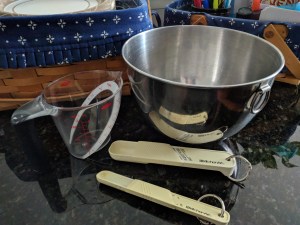
When making slime became popular, my daughter asked to make some at home. She told me that she needed white glue, Borax, laundry detergent, and food coloring to make two different slime recipes. My initial thought was absolutely not! I could already see the sandy Borax all over my floor, stained chair cushions, sticky glue handprints on my furniture, and detergent spilled everywhere. Knowing my penchant for cleanliness, my daughter quickly added that she could make it in our basement and she promised to be very careful. I put aside visions of myself sweeping up Borax and agreed to let her make it. As a former educator, I knew this would be a great authentic learning experience. Of course, I didn’t share that with my daughter!

When we arrived at the store to purchase the ingredients, I stood back and let her shop using one of her birthday gift cards. Spending the least amount of money possible was suddenly very important to her since she was paying! When she checked the recipe using Borax, she saw that it it needed 1⁄2 cup of white glue. However, the glue bottles were labeled in ounces. I told her we needed to convert the units. She already knew there were 8 ounces in one cup, so she halved it to find that 1⁄2 cup was 4 ounces. She “did math” without realizing it! The recipe also needed 1 teaspoon of Borax. Upon finding it in a 4 pound box, she happily stated that it was enough to make slime forever! At this point I had to hold onto the cart because I suddenly felt faint. The words forever and slime should never be in the same sentence.

To make slime using laundry detergent (which is also labeled in ounces), the recipe called for 1⁄4 cup. At first she picked up a very large bottle. When I reminded her to check the recipe, she figured out that she only needed 2 ounces of detergent. This enabled her to buy the smallest (and cheapest!) one. More authentic learning. This recipe also needed 1⁄2 cup of glue, so 8 ounces was needed in order to make both recipes. I advised her to check the price of the 4 ounce bottle and the 7.6 ounce bottle. She figured out that the larger bottle was less money than two 4 ounce bottles, so she chose the 7.6 ounce bottle instead. She said it was close enough to 8 ounces. So frugal with her own money. And more hidden math!

Upon returning from the store, I asked my daughter how the ingredients actually became slime. She had no idea. Neither did I – it’s been a long time since my high school chemistry class. I seized this teachable moment and quickly (very quickly – I didn’t want to lose my audience) looked up how slime forms. Basically the glue is a polymer and the Borax and detergent are activators. When they mix, a reaction occurs that causes the molecules in the glue to become tangled and create a slimy substance. Quick authentic chemistry lesson!

To make the Borax slime, she carefully measured each ingredient (“doing math” again), followed the directions, and was quite excited when slime formed! It actually was pretty cool! Then she followed the recipe for the laundry detergent slime. She liked the consistency of the detergent slime better because it was softer and more stretchy. I liked it better because we were able to relegate the sandy Borax to a dark corner of the basement.

Over the next few months, my basement became a slime factory and my daughter and her friends became expert slime makers. They learned how to alter the consistency of the slime by experimenting with different amounts of each ingredient and recorded the recipes they liked. They also made the equally important discovery that some combinations did not make good slime. They modified recipes to make larger or smaller batches and created various hues with the food coloring. Making slime provided authentic learning experiences with basic measurement, a tiny bit of finance, and a bit of elementary chemistry. My daughter had hours of fun and never realized she was learning! And I never told her!

Authentic Teaching – Poetry

IMG_20180829_130155

I had a great conversation the other day with a girlfriend about authentic learning.  I was explaining how it makes all the difference in the world when the project is something the student is interested in – if the students are not interested, then it really isn’t authentic.  Having fifth-grade boys read Robert Frost’s poems, and then write poetry in that style has never been a very meaningful or successful endeavor.  (I am a Robert Frost fan, but for some strange reason most fifth-grade boys are not.)  Exposing students to many different poets and styles of poetry, then having them pick a style they like, and you are moving into the authentic experience.  They can then write poems in that style about an interest they have, and you can watch the engagement happen.

I mentioned that, of course, most of my boys were passionate about football.  Most of them wrote poems about football.  She asked if I knew a lot about football.  I confessed my knowledge was limited, mostly things I picked up from my Miami Dolphin fan brothers and son.  (Cue the violins here for the long-suffering Dolphin fans.)  I am a “Dolfan”, but certainly don’t have a ton of football knowledge. I wore my turquoise and orange, and professed my true love, which the boys fell over laughing about.  (I taught in Redskin territory so it’s not like they had a lot to laugh at me about!)  Honestly, my background knowledge about football didn’t matter.  I knew how to teach poetry, I knew how to guide children through an authentic learning experience, and the boys certainly knew enough about football to take it from there.

*If you give this a try – after the poems are written, continue with a poetry reading, complete with refreshments (party planning/math budgeting), or create a poetry newsletter to be shared with people at a retirement home, or sell that newsletter and raise money for charity….the authentic options are endless.

Tex the Explorer: Journey to Mars in the Classroom

IMG_20180731_073642

Available on Amazon

A friend asked for ideas on how to use Tex the Explorer: Journey to Mars in her classroom, and I thought this was a great question!

I came up with two ideas.

First of all, I hope it is a great book to use to support the study of the planets in the primary grades.  All of the information in the book about Mars is factual. (I have space scientists in my family and had all my facts triple checked!)  I have heard from folks who bought the book, that it is a great conversation starter for kids about space.

Another use for the book would be that it was written by a teacher and illustrated by her former student.  Neither of us are professionals, and neither of us has done anything like this before.  I hope it would be an authentic inspiration for students to write their own books about what they are passionate about.  You don’t have to  get your book published and sell it on Amazon for it to be a real book.  With technology today, it is fairly simple to produce a book to share with friends.  Holding a “book fair” to showcase student work would be a great way to present final products.

I would also be honored to communicate with students who are working on writing their own books.  I am happy to email, Skype, or visit in person – if you happen to live in Central Pennsylvania, the DC suburbs, or any place I could use as an excuse for a good trip – Venice would definitely be doable!  If you are in the DC area, I could also see if my illustrator is available.  He is pretty busy with college, but I might be able to get him to join me on a visit.  Again, it’s those interactions with real people that have accomplished real things that make the experience authentic.

*If you use Tex the Explorer: Journey to Mars in your classroom, please let me know how!

Authentic Teaching – Time Zones

IMG_20180817_194111

Over a decade ago, when webcams were just being introduced, I was told about a fantastic webcam in the polar bear exhibit in the Alaskan zoo.  I looked at it after school and it was amazingly cool (pun intended).  It also supported an authentic project I was doing with a group of kids about the fifty states.

So the next morning I very excitedly invited several students to my office to view the polar bears.  We logged on to the webcam and…..nothing!  Black screen.  I was so bummed.  The teacher who told me about the webcam happened to stop by, and we told her the webcam was broken.  She looked at me like I was a total idiot (she was one of those very expressive people), and said, “Duh, it’s 5:00AM in Alaska and it’s winter.”  This led to a very authentic conversation about time zones, and sunrise/sunset at different latitudes.

*There are many live webcams in zoos all over the world.  Check them out for some great authentic viewing!

Authentic Project Ideas – The Smart Watch

IMG_20180823_091448

With all the fancy Fitbit, Garmin, Google, Amazon, etc., smart watches out there, I thought it might be a cool authentic project for students to design their own devices.

This idea came to me on an airline flight when my husband was obsessing over the fact that his Garmin watch was calculating altitude by air pressure rather than GPS.  As the plane was pressurized (this is a good thing), his watch was reporting altitude by air pressure inside the plane, rather than the altitude the plane was at.  I am sure there are many further examples like this that older students could research, learn about, and maybe even figure out a “fix.”  They could also design their own devices with all the capabilities that they would like.

For younger students this could be more of a fun “imagineering” (thanks Disney for that word) project where they design watches with all of the capabilities that they would want.  They could also research what is available, what they could like to add, and create their dream smart watch. This could also include some authentic practice in telling time.  (Listen for the opportunity and work that skill in.)

*I would like mine to be able to, with the press of a button, bring down the temperature of any room to a lovely 69 degrees!  Oh, and instantly connect to Amazon for shopping. And give me “step” credits for said shopping.  And how about a map directing me to where my favorite television star is hiding (hint – he is Scottish and gorgeous).  And…gosh I may have to do some research and complete this project myself!

Authentic = Real Learning

IMG_20180815_105004

Even though I am passionate about authentic learning, and my blog is  focused on how important the authentic experience is, even I sometimes forget just how important!

I recently had the opportunity to participate in a glassblowing workshop.  I have attended many craft workshops that in all actuality were demonstrations.  The members of the audience sat and watched while the instructor completed the project.

In this particular workshop, it was not a demonstration, but a real hands-on experience.  The glassblower was right there with you, but you were the one molding, turning, and creating the design on the glass.  We picked the colors we wanted to use, learning about how colors change when heated.  We learned how to add designs to the surface of the glass, actually using a nail on the end of a pole to scratch the design into the glass and move the glass around on the surface.  And we learned the techniques to blow the glass into the shapes we wanted. (OK – the instructor was VERY hands on here, this takes a great deal of experience to get the shape you want. But he was really good at letting us “believe” we were actually doing this by ourselves!)

I honestly don’t remember ever being this excited or engaged during any other glass (or craft) workshop that I have attended.  My engagement and ownership of the learning was real.  I left with a deep understanding of how colors and designs are added to blown glass, and how different shapes are created – an understanding that I had not gained during previous “demonstration” workshops.

Working with two-thousand-degree glass is not an easy thing to do, and safety is a huge concern.  This is probably why glass workshops I had previously attended were really just demonstrations.  I  left those “workshops” feeling entertained, but a little disappointed.  (I almost didn’t sign up for this one because – been there, done that, but didn’t learn a lot.)

It certainly took more time, effort, and attention to safety to make this a real workshop, but the effort was well worth it.  The other students attending this workshop all commented on how amazing it was and how they gained so much knowledge about glassblowing. (The ages of the “students” ranged from ten to sixty-five, and everyone was totally engaged.)

As I sat at home waiting for my beautiful creation to arrive in the mail (they had to be slowly cooled down over several days so that the glass didn’t shatter), I was reminded once again of the difference the true authentic learning experience makes.

IMG_20180825_170234And here it is!  Please feel free to comment that it is the most amazing glass masterpiece that you have ever seen.