Authentic Teaching – Grocery Store Math/Budgeting

IMG_20180801_082331

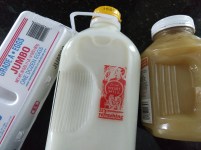
Children often want certain items at the grocery store (ok make that usually/always).  If treats are in the family budget, younger children can be given a number of items that they can pick (one is absolutely fine and appropriate).  If a package of treats is purchased, they can be counted, and agreed to be consumed one day at a time, or shared with family members (again counted to make sure there are enough).  Older children can be given a monetary amount that they can spend.  And even with young children it is never too early to explain what a budget is, and what can and can not be included in the family budget – another authentic way to reinforce math concepts.

Authentic Teaching – Grocery Store Math/Estimation

IMG_20190416_172831491

Estimation is often a tricky concept for kids to grasp.  Estimating what the total will be at the grocery store is a great authentic way to reinforce this concept.  Kids can start with estimating at $2.00 per item.  (This is also great practice for younger children to count by twos.)  This can be refined to adding more dollars for more expensive items and eventually rounding up or down to the nearest dollar.

*My grandmother taught me to do this using $0.50 per item…I guess we can teach inflation using this activity also!

Authentic Teaching – Grocery Store Math/Counting

IMG_20180801_082624

Young children can learn and practice counting by counting items as they go into the shopping cart.  Simple and quick, and an invaluable authentic counting practice.

It’s the authentic experience in reading, writing, and math (really in all academic disciplines) that truly make a difference in what a child will not only learn, but internalize and use.  Exposure in isolation does not have the same impact as the authentic experience.  Drilling for hours doesn’t come close to the impact of the quick but authentic hit.

The Authentic Experience

IMG_20180730_121327

It’s the authentic experience in reading, writing, and math (really in all academic disciplines) that truly make a difference in what a child will not only learn, but internalize and use.  Exposure in isolation does not have the same impact as the authentic experience.  Drilling for hours doesn’t come close to the impact of the quick but authentic hit.

Most teachers and parents are extremely busy and may overlook the quick and easy authentic experience for children.  One of the main focuses of this blog is a reminder about all of those wonderful authentic teaching moments out there.  Sometimes I’ll go into detail if I think the details are important, but usually I’ll try to just put out a quick note about anything that strikes me as a great authentic learning moment for kids.

This also pairs with my favorite teaching and parenting strategy, the “Model Your Thoughts Out Loud” strategy.  By voicing your thoughts out loud for organization, planning, problem solving, etc, you are modeling behavior for children to internalize.  This can be talking in front of children to a co-worker, spouse, partner, relative, friend, caregiver, or even out loud to yourself.  What is important is that kids hear how and why things happen.  Events don’t just magically occur and things don’t magically appear without organization, planning and problem solving.  I will post ideas about this as well.

My last main focus will be authentic project ideas for teachers.  Again, I will go into detail when the details are important, but often I’ll just relay ideas that come to me, or that I come across.


Authentic Teaching – Pizza and Fractions


IMG_20180730_171358

When ordering pizza – use fractions to discuss the slices and how many pieces everyone ate.  I ate 1/2 while you ate 1/3.  If I ate 1/2 of a small pizza and you ate 1/3 of an extra-large pizza, did I eat more?  If I ate 1/2 of a pizza and you ate 4/8 of the same pizza, who ate more?  Lots of authentic ways to teach fractions.

You can also teach the early vocabulary of fractions with young children.  When discussing ordering a pizza you can use words like whole, half, and quarter.  “Half” the pizza with cheese, and “Half” with pineapple and ham (my favorite).  Hmmm…gotta go order pizza for lunch now!

Authentic Teaching – Turning a Wait into a Math Lesson

IMG_20180725_143227

I was waiting for Metro on a summer day, in a Washington, D.C. station.  The station was hot, crowded, and the trains were running late.  As I stood waiting, I noticed two mothers nearby, both with young sons.  Both children were whining, and my initial reaction was relief that I was not also dealing with a young child in this heat, bad enough I had to stand here and wait myself.  But as I stood watching, I was struck by the different way in which the two mothers were dealing with the wait.

One mother was explaining that the trains were running slow because they were so crowded.  She pointed up at the display that showed the wait for the next train, and started counting down with the numbers on the display.  Her child stopped whining, and became engaged with watching the seconds and minutes count down.  Not only was she teaching her child patience with patience, but she was also developing math skills.

The second mother reacted to her whining child with a swat on the behind, and language that really surprised me. Language not appropriate for sailors in a bar (no offense intended to sailors in bars), and certainly no way to model behavior for a child.  She also threatened to not get him a promised treat later.  His behavior escalated, hers escalated…and I am sure I don’t need to explain the moral of this story.

The Authentic Learning Experience


Scan 6 (4)

Ingredients for an Authentic Learning Experience:

Ownership

Early foundation

Real-world application

Deliberate incorporation of student interest

Openness to the unplanned learning opportunity

Integration of content

Active learning

Valuing student inquiry

Learning from failure

Engagement

From One School’s Journey by Eleanor K. Smith and Margaret Pastor (coming Fall 2018)

Teachers – Don’t Put Up Those Bulletin Boards Before School Starts!

Scan 9

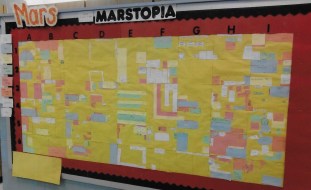
A few years ago, my principal gave me an empty classroom to reverse terraform into a Prototype Martian Colony.  I walked into the empty classroom and as excited as I was, my heart sank when I saw the condition of the classroom (the classroom had been empty for a few years – you can picture what it looked like).

The first thing I decided to deal with was covering the bulletin boards with paper.  After five minutes of staring at the boards (they didn’t appear to be covering themselves), I decided to get the fifth-graders to help me.  School had already started, so I could borrow a few kids from the classroom I co-taught in.  I figured five bulletin boards, at an hour per board, we could easily finish this in less than a day.  The fifth-grade teacher happily lent me a few of her kids.  She actually did a quick authentic math lesson – if there were five boards, and we had twenty-seven kids in the class, how many kids should work on each board?  And how should we handle the two extra students as there was a remainder?  (It is truly amazing how many opportunities there are in a school day that teachers miss for these quick authentic lessons.)  We walked across the hall to the empty classroom and as I started to issue instructions I suddenly realized I also had a golden opportunity here for some authentic teaching and learning.  So I pulled up a chair, sat down, and told the kids to cover the first of the five uncovered boards.

After an hour we had finished covering – nothing!  The kids had absolutely no idea what to do.  Five years of doing hundreds of worksheets on measurement and solving “story problems” and they had no idea how to measure, cut paper, and cover a bulletin board.  I began to give some hints, and retaught how to use a ruler (actually measuring something real – authentic – not a line on a piece of paper).  The kids had discussions about how to measure, what to use to measure (ruler versus yard stick), what side of the ruler/yardstick to use (U.S standard versus metric) what color to use, where to get the paper from, how to ask the media specialist (politely) for access to the bulletin board paper, getting the paper back to the fifth-grade wing without tearing it – the experience moved way beyond simple measurement.

The kids finally covered half the board, and they realized the paper was not wide enough to cover the entire board.  But two pieces were too wide.  What should they do? At the end of the day, one board was covered.  Yes, they had been out of class for a day, but the phenomenal classroom teacher understood the value of authentic learning, and when I returned the first group of students, she gave me five more to work on the second board.  This went faster as there had been some prepping of the second group by the first group on the playground (math language/cooperation/strategy sharing).

What I thought would be a one day task, took a week.  We got those boards covered.  And the one board that had a slight tear in one section we covered with a picture of Marvin the Martian and no one was the wiser.  It turned out this was a strategy the classroom teacher often used when she covered boards and there was a rip, or the paper didn’t line up perfectly.   Great problem solving strategy – and this also became a class inside joke the entire year!

So as I reflected on this, it dawned on me that instead of teachers spending their precious time before the kids come back to school in the fall, covering and creating bulletin boards, let the kids do it.  This is a golden opportunity for the students to engage in an authentic learning activity.  And it also gives them increased ownership of their classroom. (Those fifth-graders had total ownership over the “Martian Colony” classroom, and it started with covering the boards.  And when students “own” something the engagement and learning multiplies exponentially)  Even kindergarten students can help cover bulletin boards.  This does mean that students will return to blank bulletin boards in the fall, but a simple “Under Construction by Students” sign explains the blank boards on opening day.  And I can guarantee this one project will result in students understanding, and internalizing, measurement skills far better than completing hundreds of worksheets!
Authentic Teaching – The Budget

IMG_20180725_120138

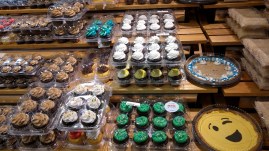
Having children work out and stick to a budget is a great authentic way to teach and reinforce math skills.  It is also a way to show children how to find out what something might cost and to stick to a budget.

For example, for classroom or home parties, give children an amount to work with, give them websites they can search to find prices, and let them plan the party.  Giving children ownership of the budget and planning provides an authentic math experience, and also gives the children ownership and pride in their event.

Authentic Teaching – Restaurant Math

IMG_20180725_113218

Here is another math idea for children while eating at restaurants.  My mom actually came up with this idea when I was a child and had discovered shrimp cocktails.  To make us aware of how much we were spending at restaurants, she played a game called “Guess the Check.”  After the first time, we would expect this, and my brothers and I would listen to everyone order, check the prices on the menu, and add up the cost in our heads.  Not only was this a great way to develop authentic math skills, but it also made us aware of what we were ordering/spending at a restaurant.  After a conversation about family budgets and eating out, my order of the expensive shrimp cocktail ceased (except when my grandparents came to town and were treating – that is what grandparents are for!)