Authentic Teaching – Time Zones

IMG_20180817_194111

Over a decade ago, when webcams were just being introduced, I was told about a fantastic webcam in the polar bear exhibit in the Alaskan zoo.  I looked at it after school and it was amazingly cool (pun intended).  It also supported an authentic project I was doing with a group of kids about the fifty states.

So the next morning I very excitedly invited several students to my office to view the polar bears.  We logged on to the webcam and…..nothing!  Black screen.  I was so bummed.  The teacher who told me about the webcam happened to stop by, and we told her the webcam was broken.  She looked at me like I was a total idiot (she was one of those very expressive people), and said, “Duh, it’s 5:00AM in Alaska and it’s winter.”  This led to a very authentic conversation about time zones, and sunrise/sunset at different latitudes.

*There are many live webcams in zoos all over the world.  Check them out for some great authentic viewing!

Authentic Project Ideas – The Smart Watch

IMG_20180823_091448

With all the fancy Fitbit, Garmin, Google, Amazon, etc., smart watches out there, I thought it might be a cool authentic project for students to design their own devices.

This idea came to me on an airline flight when my husband was obsessing over the fact that his Garmin watch was calculating altitude by air pressure rather than GPS.  As the plane was pressurized (this is a good thing), his watch was reporting altitude by air pressure inside the plane, rather than the altitude the plane was at.  I am sure there are many further examples like this that older students could research, learn about, and maybe even figure out a “fix.”  They could also design their own devices with all the capabilities that they would like.

For younger students this could be more of a fun “imagineering” (thanks Disney for that word) project where they design watches with all of the capabilities that they would want.  They could also research what is available, what they could like to add, and create their dream smart watch. This could also include some authentic practice in telling time.  (Listen for the opportunity and work that skill in.)

*I would like mine to be able to, with the press of a button, bring down the temperature of any room to a lovely 69 degrees!  Oh, and instantly connect to Amazon for shopping. And give me “step” credits for said shopping.  And how about a map directing me to where my favorite television star is hiding (hint – he is Scottish and gorgeous).  And…gosh I may have to do some research and complete this project myself!

Authentic = Real Learning

IMG_20180815_105004

Even though I am passionate about authentic learning, and my blog is  focused on how important the authentic experience is, even I sometimes forget just how important!

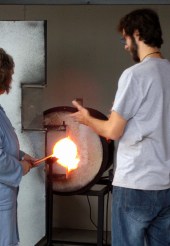
I recently had the opportunity to participate in a glassblowing workshop.  I have attended many craft workshops that in all actuality were demonstrations.  The members of the audience sat and watched while the instructor completed the project.

In this particular workshop, it was not a demonstration, but a real hands-on experience.  The glassblower was right there with you, but you were the one molding, turning, and creating the design on the glass.  We picked the colors we wanted to use, learning about how colors change when heated.  We learned how to add designs to the surface of the glass, actually using a nail on the end of a pole to scratch the design into the glass and move the glass around on the surface.  And we learned the techniques to blow the glass into the shapes we wanted. (OK – the instructor was VERY hands on here, this takes a great deal of experience to get the shape you want. But he was really good at letting us “believe” we were actually doing this by ourselves!)

I honestly don’t remember ever being this excited or engaged during any other glass (or craft) workshop that I have attended.  My engagement and ownership of the learning was real.  I left with a deep understanding of how colors and designs are added to blown glass, and how different shapes are created – an understanding that I had not gained during previous “demonstration” workshops.

Working with two-thousand-degree glass is not an easy thing to do, and safety is a huge concern.  This is probably why glass workshops I had previously attended were really just demonstrations.  I  left those “workshops” feeling entertained, but a little disappointed.  (I almost didn’t sign up for this one because – been there, done that, but didn’t learn a lot.)

It certainly took more time, effort, and attention to safety to make this a real workshop, but the effort was well worth it.  The other students attending this workshop all commented on how amazing it was and how they gained so much knowledge about glassblowing. (The ages of the “students” ranged from ten to sixty-five, and everyone was totally engaged.)

As I sat at home waiting for my beautiful creation to arrive in the mail (they had to be slowly cooled down over several days so that the glass didn’t shatter), I was reminded once again of the difference the true authentic learning experience makes.
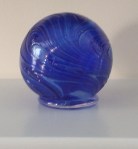
IMG_20180825_170234And here it is!  Please feel free to comment that it is the most amazing glass masterpiece that you have ever seen.

 

Authentic Teaching – Biographies

Scan 18

Almost every curriculum has a grade level objective of writing a biography.  Writing about a famous person is a great objective, as long as the student is really interested in,  and has a connection to, the person they are researching.  If this isn’t present, it is just another exercise where little to no learning will be internalized.

Writing biographies can easily be incorporated into an authentic project.  For the group of students I worked with who did the year long State Fair Project, we had them write a biography about someone famous from their state. (Definition of “from” included –  born there, lived there, worked there, retired there…) Not only did this tap into their interest about the state they “owned” for the year, it also allowed them a great deal of latitude in picking a person who really interested them.  We even managed to find a subject for a young lady who was determined to research and write about a figure skater – and her state was Florida!  (This was a bit of a stretch, but an Olympic Gold Medalist in figure skating from Canada had spent her later years retired in Florida – worked for us!)

The Authentic Experience – Time Zones

chrisjan20131Quilt by Chris Staver

I am passionate about Authentic Teaching and Authentic Experiences, because I believe that is truly the way we internalize learning.  I  just returned from a marvelous trip to Alaska.  I kept a list of entries I wanted to add to my blog when I returned home.  However, yesterday we traveled for 22 hours through four time zones, arriving home at 4AM.  So in order to publish somewhat coherent blogs, they will have to wait for another day or two!

Having completed hundreds of worksheets on calculating time and time zones as a student (and admittedly giving students hundreds to do as well during my early years as a teacher) I can honestly state that nothing compares to the authentic experience of resetting you watch four times, recalculating your departure and arrival times, and trying to drag yourself out of bed the next day suffering from severe jet lag.  I definitely internalized the “time zone” concept!   Bye for now…gotta go take a nap!

*I promise to publish ideas for teaching the concept of time zones in future blogs – once my brain fog clears!

Authentic Project Ideas – The State Fair

Scan 17

I am a huge fan of geography and love authentic projects that teach geography.  I was involved in an extremely successful project where each child picked a state in the United States to study.  Actually, they had to write a letter to the classroom teacher persuading the teacher to let them study the state they were interested in.  To do this they were already researching states for material for their persuasive letters (reading/writing).

The students then spent the entire school year learning about their state.  We tied the state research into reading, writing, and math.  (I’ll post individual blogs with ideas on how to do this – way too much for one blog!)  At the end of the year we presented what they had learned in a State Fair.

Authentic Project Ideas – Adopting the Elderly

IMG_20180803_201456 (1)

There are many possible authentic projects for students that would like to adopt older folks from an assisted care community or residence.

A few ideas (depending on the number of students involved, these ideas can be for all residents, a few, or even just one):

Get a list of everyone’s birthdays in the residence, chart/graph this and make cards for birthdays.

Create surveys asking residents about favorite things, write stories, poems, etc., based on the results of the survey.

Make cards, ornaments, placemats etc., as gifts for holidays.

Create and send a student generated monthly newsletter, magazine,  or newspaper.  Copy for each resident.

I also found this on Facebook:

The International Card Exchange for the Elderly

It lists homes that are asking for cards.  Listings are international –  a great authentic tie in with geography.  *I am not sure how current this page is, make sure and check out that a listing is current before you have students create cards.

Authentic Teaching – Party Planning

Scan 8 (1)

A great authentic way for children to learn about budgeting – give them a budget for their birthday party or other special event.  It is truly amazing to watch what happens when children have a budget to work with.  Not only is this great math practice, but whining ends, creativity increases, and kids end up having pride and ownership over their own special day.  Win Win!

Authentic Teaching – Grocery Store Math/Budgeting

IMG_20180801_082331

Children often want certain items at the grocery store (ok make that usually/always).  If treats are in the family budget, younger children can be given a number of items that they can pick (one is absolutely fine and appropriate).  If a package of treats is purchased, they can be counted, and agreed to be consumed one day at a time, or shared with family members (again counted to make sure there are enough).  Older children can be given a monetary amount that they can spend.  And even with young children it is never too early to explain what a budget is, and what can and can not be included in the family budget – another authentic way to reinforce math concepts.