Authentic Teaching Opportunities – Project Presentations, and more…

state fair 1

Adults often do many things for children that they can do for themselves, especially when preparing for a project.  We all know how important it is to be prepared for a lesson with students.  But being prepared, and adults doing work that students can learn from, are two very different things.  Planning and gathering materials for a project are important activities that students can and should be involved with.  When plans miraculously happen, and materials just appear, many learning opportunities are lost.

When we presented the State Fair to other groups of students, many math opportunities occurred.  There was measurement to plan how to set up the fair in the space we had available.  There was discourse and compromise among students to agree on how to place each state in the fair – Alaska wanted to display the states alphabetically, Texas by size, California by population…   A schedule was developed – after the students figured out how much time each group would need at the fair based on number of displays to visit and how much average time would be spent at each display.  Groups were invited based on this schedule.  Then the schedule was adjusted for groups that had a conflict with the available times.  Then the schedule was re-adjusted after the first day when the students realized larger groups and older students needed more time at the fair than smaller and younger groups, etc.

There are many math opportunities for parents working with children at home as well.  When inviting other children over make sure your child is involved in this discourse.  You would be surprised how much math you use every day without even realizing it.   (Except of course when I balance my checkbook.  Then I totally realize how much math is involved as I try to make sense of the usual mess I have made!)

The State Fair Project – Teaching Math

State Fair 2

When we developed The State Fair Project in fourth grade there were countless opportunities to use math.  During the year we were constantly looking at statistics for each state.  Size, population, socio-economic make-up, average temperature, significant dates…  All of these numbers were looked at and discussed.  The numbers were used not only to compare and contrast the 50 states but to develop some cause and effect hypotheses.

If the average temperature of a state was warmer than most, how would this effect the size of the population.  How about the average age of the population?  Why would older people tend to live in a warmer climate? Why would more Olympic skiers grow up in specific states?  But, why were there Olympic figure skaters training in Florida?

Every statistic became a jumping off point for further discussion and research.  Questions created more questions.  The use of math was constant, fluid, and authentic. (And of course, reading and writing skills were strengthened as well.)

*This authentic project can be easily adapted for territories, counties…whatever system the country you are studying uses.

Real Authentic Learning

IMG_chocolate chips

Doing projects with kids is a great starting point for learning.  But the goal should be for the authentic learning experience.

Following directions for an arts and crafts project, or following a recipe, is definitely great practice using reading and math.  However, if it stops there, the opportunity for real authentic learning is lost.  I don’t think we can state often enough that we are raising children to function in a world that we can’t possibly imagine.  Many of the jobs they will hold in the future don’t exist yet.  And more importantly, many of the jobs people hold today, will not exist in the future.  The children we are educating today need to be able to think outside the box if they are going to have a chance to really succeed in the world they will live in as adults.  Simply following directions to get from Point A to Point B, or repetitive drills filling in correct answers on a worksheet, is not going to prepare them for the future.

Following a recipe, or a set of instructions, should just be the starting point.  The real authentic learning occurs when adults listen to what children are saying while they are working, and follow up on this discourse.  Why just one cup of chocolate chips?  What would happen if we used two cups?  Do generic chocolate chips really taste the same as the more expensive Nestle brand?  Can you taste the difference in the finished product?  How can we test this?…

Sometimes adult prompting is needed to take the project to the authentic level.  But often, just listening to children, really listening, provides the springboard to that authentic learning experience.

Authentic Teaching – The Read Aloud

IMG_Titanic 2

From my Exceptional Parent/Teacher Guest Blogger Carissa Yfantis-

“The wind began to blow. The tree house started to spin.” In case you don’t recognize those famous lines, they are from ​The Magic Tree House​ series of fiction adventure books for young readers. They are the opening lines that lead the main characters to an adventure in each book. When my daughter was 4 1⁄2 years-old, my friend gave her a complete set of the first 28 books for Christmas. She had begun reading them to her own daughter when she was four, and they both adored them. My friend assured me that if we read them aloud to my daughter, we would all love them, too. At first, I wasn’t sure if the stories and themes would be too mature or too frightening. I previewed a few of the books, trusted my friend, and embarked on a six-month read-aloud adventure.

Back then we read aloud to our daughter at least twice a day, before afternoon rest time (formerly known as nap time – naps were a distant memory at this point, even though ​I​​still needed her to take one) and at bedtime. This gave us plenty of opportunities to read these chapter books aloud. As promised, we all loved the books immediately. Each one is based on a specific event or time period from history. Even though she was quite young, we were able to teach her little bits of history (edited as necessary to be age-appropriate) as we read the different books. Our daughter was totally engaged with the stories, and the illustrations scattered throughout each book gave a visual representation of important points in the text.

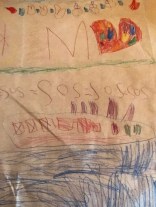
I was happy to enjoy the stories and squeeze in some history, but the best part of reading these books was the few times when my daughter was inspired to create things from the stories. At some point during our second reading of ​Tonight on the Titanic, she decided to draw a picture of the ship with SOS above it. ​On her own.​ (I need to mention that we did not tell her anyone died, just that the ship sank.) I was overjoyed. The history had truly become authentic for her. In ​Haunted Castle on Hallows Eve​, the two main characters turn into ravens. We discussed what ravens were and found photos of real ones on the internet. There were also illustrations of ravens in the book. One day, she made raven’s wings out of black construction paper and a beak out of yellow paper. She asked me to tape them to her arms and face. Again, this was o​n her own.​ Knock me over with a feather. She had an authentic learning experience because this piece of the story was interesting to her.

When you read aloud with your children, whether you read to them or they read to you, there will be many opportunities to converse about the subject matter. With the world at our fingertips, you can quickly find photos, definitions, and facts about topics that interest them. Authentic learning takes place when your child actively explores a topic in a way that is meaningful to her.

By the way, lest you think we have some sort of child prodigy, her spontaneous bursts of creativity have dwindled considerably since ​The Magic Tree House​ days. Okay, they’re basically gone, but it was amazing while it was lasted!

IMG_Raven's Wings 2


ONE SCHOOL’S JOURNEY By Eleanor K. Smith and Margaret Pastor

One School's Journey_cover

Available on Amazon.  Read for free on Kindle Unlimited.

I am very excited to announce that my book about Authentic Learning with my former and forever principal, Peggy Pastor, is now available on Amazon in both paperback and Kindle editions.  Click on the Amazon link above to check it out!

One School’s Journey tells the story of an elementary school in Maryland, in the suburbs near Washington, D.C.  The school’s student population is extremely diverse, with students representing many races, socio-economics levels, and academic abilities.  The path towards the use of authentic projects to teach and reach this diverse population is chronicled by the two authors –  Eleanor K. Smith (me), a teacher, and Margaret Pastor, the building principal.

While offering procedure, guidance, and examples, this is not a book of lesson plans.  Our bias is that for true authentic teaching you cannot follow someone else’s lesson plans.  Authentic projects come from the heart and are adapted to meet the needs and interests of the students.

This book is about the journey of the staff at our elementary school, as we set down the path to discover how to engage our students.  What was not a surprise, was that when children are engaged, they learn. And authentic projects engage the learner.   Our hope is that the reader will find inspiration from what we discovered along the way.

The Authentic Teaching Moment – Hurricane Names

Clouds3

It’s easy to miss those Authentic Teaching Moments.  If you stop and listen, kids are giving us opportunities every day to engage their natural curiosity. 

From my wonderful Guest Blogger Carissa Yfantis-

News about Hurricane Florence dominated the television recently and my daughter became very interested in watching the track of the storm. As she watched the news, I shared with her my own hurricane story. When I was in 7th grade, back in 1985, Hurricane Gloria hit New York and we actually got the day off from school. The New York City Public School system NEVER closed (seriously, ​ne-ver​), so this was truly a momentous occasion. Always the studious student (okay, nerd), I used the day off to complete my current events report about the AIDS epidemic. She couldn’t believe that AIDS was a current event when I was her age and took the opportunity to remind me that I am “so old”.

Moving on from my age, I told her that hurricanes used to be named with only female names. This was interesting to her, so she decided to investigate how hurricanes are named. She found out that in 1953, the National Weather Service started giving the storms female names. Some people were upset by this, so in 1979, they began using male names also. The National Hurricane Center website informed her that there are six lists of hurricane names prepared up to the year 2023. They are recycled every six years. Some names are retired, like Katrina and Harvey because it would be inappropriate to use those names again. She learned that the World Meteorological Organization manages the system that names hurricanes. The names are chosen by the World Meteorological Organization’s Hurricane Committee and they are meant to be recognizable to people in the areas where hurricanes typically hit. Who knew any of this? A little spark of interest led to an authentic learning experience.

She scoured the six lists, and we have two family members who could have hurricanes with their names in 2019 and 2020. Both female…hmm…

The Authentic Experience

Scan 5 copy

Make it real, make it count!

It doesn’t need to be a year-long study of Mars and the creation of a Martian Colony.  Authentic teaching can also be that quick hit – the moment when something real, something important to the child, something that matters is addressed.  Those powerful interactions can remain with a child for life.

The “thinking out loud” comment is more powerful than the “lecture.”  Authentic exposure is more powerful than reading about something in a book.

Pause and pay attention to what is going on and you will be surprised at the authentic moments that are happening all around you.

Currency Exchange – The Value of a Dollar

Foreign Paper Money 2

From my wonderful Guest Blogger Carissa Yfantis-

Before a recent trip to Grand Cayman (for vacation, not to visit our hidden millions), my husband and I were lamenting the fact that their money is worth more than the US dollar and that everything would be more expensive. We explained to our daughter that the Cayman dollar was worth $1.20 for every one US dollar, and that each time we purchased something, we would be paying 20 cents more. We told her that if we exchanged one US dollar for Cayman money, we only get back 80 cents. She didn’t think this was quite fair, but she didn’t appear to be overly concerned. We didn’t tell her that sometimes you have to pay an exchange fee in addition to the conversion. A discussion for another day.

Grand Cayman accepts US dollars, and most things are priced in Cayman and US dollars to make things easier for the sun addled tourists. We did not exchange money since it isn’t necessary, but looking back, I wish we had exchanged a few dollars. Physically handing over one dollar and receiving only 80 cents back would have been an amazing authentic experience for our daughter.

Even without actually exchanging money, she had some valuable authentic experiences. When we ate at restaurants, she saw both prices on the menus. She was shocked when her chicken tenders were $14 Cayman and $16.80 US and when her spaghetti was $15 Cayman and $18 US. Now things were getting personal, but not personal enough. We were paying for her food, so this “unfair” pricing didn’t have any impact. However, when we went to the resort gift shop on our last day, the exchange rate became real. We gave her a budget of $20 US, but reminded her about the 20 cent deduction per dollar. This left her with about $17 Cayman to spend. She was less than thrilled with the automatic $3 deduction from her spending limit, but when in Cayman… She chose a Christmas ornament that was $10 Cayman and keychain that was $4 Cayman (every tween needs at least 15 keychains to hang off their backpack-with no actual keys on them.) She had to leave behind the $5 magnet (that would have ended up lost in a desk drawer for all eternity). She advised us that in the future we should pick a place where their money is worth less than ours. We advised her that next time we could leave her home!

More Testing Does Not Produce Smarter Kids

IMG_20180912_151757

I’m lying in bed reading my favorite romance novel – I could lie and say Romeo and Juliet, but too many people know what I read and would start to laugh – and take a break to do some Facebooking.

What pops up is the news that the State of Confusion (a state I previously taught in, that I won’t name) is introducing a new test to replace the current national test they are using –  PARCC – which I believe stands for Performance Anxiety Required for all Children Consistently.  While PARCC desperately needs replacing, it is the worst test I saw in over three decades of teaching, I am not optimistic that the State of Confusion will do better with the next replacement test.

Let me do a little mental review.  I am trying to remember what tests we were using when I began my teaching career.  I was teaching in a multi-handicapped deaf preschool in the south in the early 80’s.  Honestly this was not a population that you needed to waste valuable teaching time “testing”.  Think Helen Keller before Anne Sullivan. And I don’t believe we did waste time with testing.  We spent every hour, minute, and second trying to break through to these kids, to teach them how to communicate.

So, I next end up in another southern state, teaching in a gifted program, and the testing climate starts to ratchet up.  I recall entire staffs being rewarded with monetary payments if scores improved.  I happened to be shared by two schools.  In one school, scores went up, so I was rewarded as being an outstanding teacher.  The other school – in my honest opinion the better school, but with a needier population – the scores did not go up, so I was not rewarded, because I was not a worthy teacher – as evidenced by my current use of run on sentences and made up punctuation.

Now I move up the eastern seaboard (no – school systems were not throwing me out, even with my predilection for run on sentences) and I spend the next twenty-plus years dealing with one “high stakes” test after another.  I forget all the acronyms – hysterical amnesia – but the best one (I’m being sarcastic) was the one where the school got the grade, not the child.  Individual scores weren’t reported.  However, an absent child counted as a zero.  I believe the state was terrified that we would expose struggling children to chicken pox so their scores wouldn’t count.  So, and I am not making this up – my daughter, fourth grade gets the flu, during this test.  I stay home and miss the test at my school (silver lining). I get a phone call from her school.  Can she come in?  They need her score.  They don’t want a zero.  I inform the school she can’t come in as she is throwing up.  The response, “Ummm, how often, can she take the test between bouts of throwing up?”  Not making this up folks, I am not that creative.

This test also involved pulling staff for weeks before to prepare all the materials, weeks to give the test, and then weeks demoralizing staff over results.  And let’s not forget the time spent on testing pep rallies, learning testing cheers, producing testing videos….  Is there intelligent life in the Department of Education?  Beam me up Scotty!

We then moved to another test. Question, if this test was so wonderful that we used weeks giving it, and then months terrorizing staff over it, why was it replaced?  Just asking.  If I recall correctly, this one wasn’t that bad. The problem was the data was being used to really terrorize entire schools. Like, worse than ever.  And there was no interpretation of data beyond the actual score.  No thought as to what the data was actually showing.  No thought as to what was impacting the data.  A special education child enters a school in fourth grade as a non-reader.  The year ends with that child reading on a second-grade level.  Wow!  Huge Growth!  Major Success!  Wrong…failure…kid not reading on grade level.

Let’s use some common-sense folks.  If kids are coming from a high socio-economic area with multiple advanced degree parents in each house, let’s be stunned when those kids outperform kids from struggling households. Let’s be stunned when children in general education outperform children in special education.  Let’s gasp in shock when Tara Lipinksi can skate better than I can.  (This has nothing to do with anything except that I love figure skating, this is my blog, and I had not been able to work in a reference to figure skating yet.)

Homes where Shakespeare is discussed will produce students who can do better on a test about Shakespeare.  I am not sure though, that this equates to children who will grow up to be more productive adults.  Not my house – we exposed our kids to science fiction and the VHS tape set of North and South, which is why my children aced the Civil War tests in American History – because their mother was in love with Patrick Swayze. (OK…I am not even sure where to begin to fix that previous sentence, so I’ll just leave it.)  Let’s fire principals and terrorize teachers who are working in the neediest schools.  And let’s reward those that are in the buildings with kids who will learn if no one shows up to teach them.  Makes sense to me.  (This whole paragraph doesn’t work…no wonder they ran me out of so many states!)

What’s the accountability answer? I’m not sure.  Somehow we need to look for growth in each child. Growth as a learner and as a person. I’m not sure there is a test for this.  And realize that when kids come to school from families that are struggling to keep a roof over their head and food on the table, you aren’t going to see the same growth as kids who can spend more time with Authentic educational experiences at home (reading Sci Fi, watching Star Trek, and reciting all three VHS tapes of North and South by heart).  And honestly, with the pace at which our world is changing, our children are going to be doing jobs in the future that we can’t even imagine.  We want to raise children who think outside the box, don’t color in the lines, don’t follow the line-leader, write in run-on sentences, and change the world.

I am not suggesting we write those kids off who come from lower socio-economic households.  On the contrary, let’s put those kids in schools where teachers not only have the time to teach – not test and not “teaching to the test” – but can really teach and reach every child. Let’s give every child this opportunity. Major plug for Authentic teaching and Authentic learning here.

We have wasted the last three-plus decades trying to figure out how to test achievement and we haven’t figured that out.  Every year that I taught we spent (wasted) more and more time on testing instead of teaching. An enormous amount of time! HUGE amount of time. So how do we test Authentic achievement?  How do we produce smarter kids? Maybe with a leap of faith.  Let teachers teach, not test, and let the kids learn.
Reading Labels and Teaching Responsibility

IMG_20180909_110723_2

From my wonderful Guest Blogger Carissa Yfantis-

One of the first words my daughter learned to read was “nut” and not because we had read ​Guess How Much I Love You?​ several hundred times (Nutbrown Hare was always a favorite). She is allergic to some tree nuts and it was vital that she could read that word on a food label. Food labels typically state if there are “tree nuts” in the product or if it was manufactured in a facility where they are processed. We knew that as a preschooler, there was little chance she would need to independently decide if she could eat something, but being able to read “nuts” was a first step in teaching her to manage her allergies. (She already knew not to eat anything unless one of us or a teacher said it was safe for her.)

Our daughter had an authentic learning experience reading food labels when she was four years old. It was the first time she found the words “tree nut” on a package of chocolate chip cookies at the grocery store. We had practiced reading the word “nut”, looking at food labels, and finding the allergy statement at the end of the ingredients list, but this was the first time an authentic learning experience had presented itself. When she asked if she could have the cookies, I told her to read the ingredients. She had eaten chocolate chip cookies before, but not the brand she had picked up. She turned the package over, found the ingredients list and, as we had taught her, pointed to each word. I watched her face as she “read” the ingredients and saw the disappointment when she reached the familiar words “tree nuts” in the allergen statement. I gave her high-fives fit for Super Bowl winners and praised her for reading the label so carefully. I reminded her that if she had not read the label and had eaten the cookies, she could have had an allergic reaction. I was beyond proud of her and she was very excited to tell my husband that she “saved herself” at the store. She eventually chose a box of allergy-friendly cookies, so fear not, she did not suffer from lack of sugar consumption that day. That experience taught her how vital it was to read the ingredients even when the picture on it appeared to be something she could eat.

Reading food labels has had an unexpected benefit. Although I always tried to eat healthfully and limit junk food, I don’t recall ever reading an ingredients list until our daughter was diagnosed. It was (and continues to be) a truly eye-opening experience. When you are forced to read ​every​ ingredient on ​everything​, you see exactly what is in all those packaged products. It is usually not appetizing in the least. You see the chemicals, the various forms of sugar, the dyes, the preservatives, and the processed ingredients. Reading food labels has been an ongoing authentic experience for me because it has led to a greater awareness of what is in various products. It has caused me to make cleaner, more nutritious food choices. I encourage everyone to start reading food labels. Children, teens, and adults can all learn so much in the minute or two it takes to read the label. You may even decide to make a homemade version of something you were about to buy when you see all the unnecessary ingredients in the packaged version. Cooking at home lends itself to myriad authentic learning experiences.

Having food allergies has provided our daughter many authentic experiences. She now knows that ingredients may have more than one name (for example: casein for milk, sucrose/glucose/fructose for sugar, filbert for hazelnut) and she learned the importance of not cross-contaminating ingredients when cooking or baking. I hope that as she gets older, reading the ingredients will cause her to become more discerning with her food choices. For now, as long as there as there are no tree nuts in something she chooses, there can be radioactive waste in it!  Although I would obviously erase all of these experiences to erase her allergies, they provide a small compensation and a little silver lining for anyone who lives with an allergy.