Technology and Raising a Socially Responsible Child

IMG_20180922_162713149

Technology and raising a socially responsible child are totally and irrevocably connected today.  This starts with the toddler who is exposed to technology that if not monitored and controlled by a parent, can replace human interaction.  It would be difficult to argue that this is a good thing.

Human interaction, those skills that are developed early in life, are invaluable in the child’s growth and readiness to enter the school system and succeed.  However, understanding and using technology is also invaluable in the child’s growth and readiness to succeed in school.  So, what is the balance?  How should technology be used with a young child?

There are few parents of past generations who at some point did not use the television set as a “babysitter.”  With the advent of Sesame Street and Mr. Roger’s Neighborhood, there were some excellent shows on television that moved past “babysitting” and into early education.  Almost 50 years ago, my youngest brother discovered the delightful Cookie Monster, who while teaching various preschool skills, would also trade anything for a cookie.  And I will never forget Dr. Sally Ride, in an orange NASA jumpsuit, introduced on Sesame Street as the “world’s expert at counting backwards!” “10, 9, 8, 7, 6, 5, 4, 3, 2, 1, 0, Blastoff!”  This was and continues to be great stuff.

It was fairly easy for my mother to control what we were watching on television.  Most families had one television, in a family room.  Eventually, I had a small television in my bedroom, but my mother had a trust that I would use this appropriately, and honestly with only four channels, there wasn’t a lot of trouble I could get into. Star Trek, Lost in Space – she knew what I was watching, was horrified, and positive I would scare away potential boyfriends or husbands with my infatuation with sci-fi. (I married a NASA scientist.)

So fast forward to today, where there are hundreds of television channels available, many on portable devices.  There are social media pages and apps for everything.  Books, games, etc.  How do you even begin to control this?  To limit or deny exposure impacts a child’s ability to navigate technology, a skill that is expected with incoming kindergartners.

This access to technology started to explode while I was raising children.  You monitored what you could, definitely limited the amount of time kids spent “on-line,” and also assigned some responsibility to your child, based on what was age appropriate.

There really is not a hard a fast rule that applies to how much time children should be allowed to be “on-line.”  This varies by family and is also situational. Like everything else as a parent, monitor and begin to teach responsibility.

One thing you don’t want to do as a parent is to back yourself into a corner with rules and regulations, and then have to back-peddle later.  For example, on long drives and plane rides technology is invaluable.  I don’t know of an adult who hasn’t made a long trip more bearable by reading or watching a movie.  You don’t want to have a one-hour limit on technology in place, and then change that every time a new situation pops up.  And you don’t want to go on a long car ride or plane ride with a whining two-year-old when you can make the trip so much more pleasant with technology.

There is nothing wrong with starting to teach children that there is a constant evaluation going on about when and where the use of technology is appropriate.  Model your thought process out loud, and begin to teach them to make these judgment calls themselves.  The bottom line however, is that when you say put it away, it is put away.  And remember, you are constantly modeling this behavior yourself.
 

Real Authentic Learning

IMG_chocolate chips

Doing projects with kids is a great starting point for learning.  But the goal should be for the authentic learning experience.

Following directions for an arts and crafts project, or following a recipe, is definitely great practice using reading and math.  However, if it stops there, the opportunity for real authentic learning is lost.  I don’t think we can state often enough that we are raising children to function in a world that we can’t possibly imagine.  Many of the jobs they will hold in the future don’t exist yet.  And more importantly, many of the jobs people hold today, will not exist in the future.  The children we are educating today need to be able to think outside the box if they are going to have a chance to really succeed in the world they will live in as adults.  Simply following directions to get from Point A to Point B, or repetitive drills filling in correct answers on a worksheet, is not going to prepare them for the future.

Following a recipe, or a set of instructions, should just be the starting point.  The real authentic learning occurs when adults listen to what children are saying while they are working, and follow up on this discourse.  Why just one cup of chocolate chips?  What would happen if we used two cups?  Do generic chocolate chips really taste the same as the more expensive Nestle brand?  Can you taste the difference in the finished product?  How can we test this?…

Sometimes adult prompting is needed to take the project to the authentic level.  But often, just listening to children, really listening, provides the springboard to that authentic learning experience.

Authentic Project Ideas – Surviving on a Deserted Island

IMG_Maine Island 2

While on a recent journey through the northeastern waterways of the United States and Canada, I saw one small island after another.  Thinking back on the authentic project I was involved with about establishing a colony on Mars, I started to imagine what it would be like to survive on one of these islands.  What would I need to survive?  What would I eat, what kind of shelter would I need, what kinds of clothes would I need?  (OK-this is definitely a fictitious authentic project as personally I need a five-star hotel in Bar Harbor, Maine, with plenty of lobster, and lovely clothes available in the local boutiques-but I digress…)

This project would vary based on where the island was located as needs would be different based on climate, natural resources, etc.

Authentic Teaching – The Read Aloud

IMG_Titanic 2

From my Exceptional Parent/Teacher Guest Blogger Carissa Yfantis-

“The wind began to blow. The tree house started to spin.” In case you don’t recognize those famous lines, they are from ​The Magic Tree House​ series of fiction adventure books for young readers. They are the opening lines that lead the main characters to an adventure in each book. When my daughter was 4 1⁄2 years-old, my friend gave her a complete set of the first 28 books for Christmas. She had begun reading them to her own daughter when she was four, and they both adored them. My friend assured me that if we read them aloud to my daughter, we would all love them, too. At first, I wasn’t sure if the stories and themes would be too mature or too frightening. I previewed a few of the books, trusted my friend, and embarked on a six-month read-aloud adventure.

Back then we read aloud to our daughter at least twice a day, before afternoon rest time (formerly known as nap time – naps were a distant memory at this point, even though ​I​​still needed her to take one) and at bedtime. This gave us plenty of opportunities to read these chapter books aloud. As promised, we all loved the books immediately. Each one is based on a specific event or time period from history. Even though she was quite young, we were able to teach her little bits of history (edited as necessary to be age-appropriate) as we read the different books. Our daughter was totally engaged with the stories, and the illustrations scattered throughout each book gave a visual representation of important points in the text.

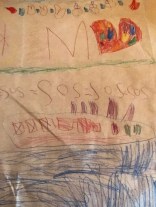
I was happy to enjoy the stories and squeeze in some history, but the best part of reading these books was the few times when my daughter was inspired to create things from the stories. At some point during our second reading of ​Tonight on the Titanic, she decided to draw a picture of the ship with SOS above it. ​On her own.​ (I need to mention that we did not tell her anyone died, just that the ship sank.) I was overjoyed. The history had truly become authentic for her. In ​Haunted Castle on Hallows Eve​, the two main characters turn into ravens. We discussed what ravens were and found photos of real ones on the internet. There were also illustrations of ravens in the book. One day, she made raven’s wings out of black construction paper and a beak out of yellow paper. She asked me to tape them to her arms and face. Again, this was o​n her own.​ Knock me over with a feather. She had an authentic learning experience because this piece of the story was interesting to her.

When you read aloud with your children, whether you read to them or they read to you, there will be many opportunities to converse about the subject matter. With the world at our fingertips, you can quickly find photos, definitions, and facts about topics that interest them. Authentic learning takes place when your child actively explores a topic in a way that is meaningful to her.

By the way, lest you think we have some sort of child prodigy, her spontaneous bursts of creativity have dwindled considerably since ​The Magic Tree House​ days. Okay, they’re basically gone, but it was amazing while it was lasted!

IMG_Raven's Wings 2


Authentic Project Ideas – Lighthouses

IMG_Portland Maine Lighthouse

I recently returned from a journey where I saw many wonderful and enchanting lighthouses.  There are so many different questions that I thought about while enjoying all of these lighthouses.  How do they work?  What purpose do they serve?  How did they operate in the past?  How and why are lighthouses built today?

What would I include in a lighthouse if I designed one? (My lighthouse would resemble a five-star hotel –  just saying.)

There are so many interesting stories about lighthouses of the past that could be a jumping off point for authentic projects.  I heard about a lighthouse keeper in Portland, Maine who became bored with just tending the lighthouse.  He began to carve wooden horses that he sold for 75 cents to the local market.  Today these horses are worth thousands of dollars each.  An authentic project could be to develop other ways to pass the time while tending a lighthouse.

While purchasing a memento of the Egg Rock Lighthouse in Bar Harbor, Maine, the charming woman at the cash register introduced herself as the granddaughter of the last keepers of that lighthouse.  She briefly shared her story with me.  I wish I had had time to hear more about her grandparents!  Another jumping off point for an authentic project, reading stories about past lighthouse keepers, and perhaps creating a compilation, journal, or even writing new stories based on past stories – endless possibilities…       IMG_Grace Little Village Gifts Bar Harbor  Grace, whose grandparents tended the Egg Rock Lighthouse near Bar Harbor, Maine


ONE SCHOOL’S JOURNEY By Eleanor K. Smith and Margaret Pastor

One School's Journey_cover

Available on Amazon.  Read for free on Kindle Unlimited.

I am very excited to announce that my book about Authentic Learning with my former and forever principal, Peggy Pastor, is now available on Amazon in both paperback and Kindle editions.  Click on the Amazon link above to check it out!

One School’s Journey tells the story of an elementary school in Maryland, in the suburbs near Washington, D.C.  The school’s student population is extremely diverse, with students representing many races, socio-economics levels, and academic abilities.  The path towards the use of authentic projects to teach and reach this diverse population is chronicled by the two authors –  Eleanor K. Smith (me), a teacher, and Margaret Pastor, the building principal.

While offering procedure, guidance, and examples, this is not a book of lesson plans.  Our bias is that for true authentic teaching you cannot follow someone else’s lesson plans.  Authentic projects come from the heart and are adapted to meet the needs and interests of the students.

This book is about the journey of the staff at our elementary school, as we set down the path to discover how to engage our students.  What was not a surprise, was that when children are engaged, they learn. And authentic projects engage the learner.   Our hope is that the reader will find inspiration from what we discovered along the way.

The Authentic Teaching Moment – Hurricane Names

Clouds3

It’s easy to miss those Authentic Teaching Moments.  If you stop and listen, kids are giving us opportunities every day to engage their natural curiosity. 

From my wonderful Guest Blogger Carissa Yfantis-

News about Hurricane Florence dominated the television recently and my daughter became very interested in watching the track of the storm. As she watched the news, I shared with her my own hurricane story. When I was in 7th grade, back in 1985, Hurricane Gloria hit New York and we actually got the day off from school. The New York City Public School system NEVER closed (seriously, ​ne-ver​), so this was truly a momentous occasion. Always the studious student (okay, nerd), I used the day off to complete my current events report about the AIDS epidemic. She couldn’t believe that AIDS was a current event when I was her age and took the opportunity to remind me that I am “so old”.

Moving on from my age, I told her that hurricanes used to be named with only female names. This was interesting to her, so she decided to investigate how hurricanes are named. She found out that in 1953, the National Weather Service started giving the storms female names. Some people were upset by this, so in 1979, they began using male names also. The National Hurricane Center website informed her that there are six lists of hurricane names prepared up to the year 2023. They are recycled every six years. Some names are retired, like Katrina and Harvey because it would be inappropriate to use those names again. She learned that the World Meteorological Organization manages the system that names hurricanes. The names are chosen by the World Meteorological Organization’s Hurricane Committee and they are meant to be recognizable to people in the areas where hurricanes typically hit. Who knew any of this? A little spark of interest led to an authentic learning experience.

She scoured the six lists, and we have two family members who could have hurricanes with their names in 2019 and 2020. Both female…hmm…

Authentic Project Ideas – Designing a Better Airplane

IMG_plane 2

Having recently flown on a Dreamliner (and that plane is a dream to fly in) I was thinking about how airplanes, especially the wings, have changed in the last few decades.  Wing-tips were added, and have changed several times. Why?

I thought this might be an interesting authentic investigation and project – doing research on why airplane and airplane wings have changed.  Students could design and present their ideas for improved airplanes.  Older students could focus on aerodynamics and airplane wings, new building materials used for planes, etc.  Younger students could focus on interior changes to the inside of planes.

*I fall into the “younger student” aka “I don’t understand aerodynamics” category!  My plane is going to have wider, more comfortable seats including armrests for each passenger – in coach class!  Only two seats per row on each side, so that you are not climbing over, or being climbed over when someone needs to get up.  Better food, more movies, the Ice Skating Network…

The Authentic Experience

Scan 5 copy

Make it real, make it count!

It doesn’t need to be a year-long study of Mars and the creation of a Martian Colony.  Authentic teaching can also be that quick hit – the moment when something real, something important to the child, something that matters is addressed.  Those powerful interactions can remain with a child for life.

The “thinking out loud” comment is more powerful than the “lecture.”  Authentic exposure is more powerful than reading about something in a book.

Pause and pay attention to what is going on and you will be surprised at the authentic moments that are happening all around you.

Currency Exchange – The Value of a Dollar

Foreign Paper Money 2

From my wonderful Guest Blogger Carissa Yfantis-

Before a recent trip to Grand Cayman (for vacation, not to visit our hidden millions), my husband and I were lamenting the fact that their money is worth more than the US dollar and that everything would be more expensive. We explained to our daughter that the Cayman dollar was worth $1.20 for every one US dollar, and that each time we purchased something, we would be paying 20 cents more. We told her that if we exchanged one US dollar for Cayman money, we only get back 80 cents. She didn’t think this was quite fair, but she didn’t appear to be overly concerned. We didn’t tell her that sometimes you have to pay an exchange fee in addition to the conversion. A discussion for another day.

Grand Cayman accepts US dollars, and most things are priced in Cayman and US dollars to make things easier for the sun addled tourists. We did not exchange money since it isn’t necessary, but looking back, I wish we had exchanged a few dollars. Physically handing over one dollar and receiving only 80 cents back would have been an amazing authentic experience for our daughter.

Even without actually exchanging money, she had some valuable authentic experiences. When we ate at restaurants, she saw both prices on the menus. She was shocked when her chicken tenders were $14 Cayman and $16.80 US and when her spaghetti was $15 Cayman and $18 US. Now things were getting personal, but not personal enough. We were paying for her food, so this “unfair” pricing didn’t have any impact. However, when we went to the resort gift shop on our last day, the exchange rate became real. We gave her a budget of $20 US, but reminded her about the 20 cent deduction per dollar. This left her with about $17 Cayman to spend. She was less than thrilled with the automatic $3 deduction from her spending limit, but when in Cayman… She chose a Christmas ornament that was $10 Cayman and keychain that was $4 Cayman (every tween needs at least 15 keychains to hang off their backpack-with no actual keys on them.) She had to leave behind the $5 magnet (that would have ended up lost in a desk drawer for all eternity). She advised us that in the future we should pick a place where their money is worth less than ours. We advised her that next time we could leave her home!