Authentic Project Ideas – Designing a Better Airplane

IMG_plane 2

Having recently flown on a Dreamliner (and that plane is a dream to fly in) I was thinking about how airplanes, especially the wings, have changed in the last few decades.  Wing-tips were added, and have changed several times. Why?

I thought this might be an interesting authentic investigation and project – doing research on why airplane and airplane wings have changed.  Students could design and present their ideas for improved airplanes.  Older students could focus on aerodynamics and airplane wings, new building materials used for planes, etc.  Younger students could focus on interior changes to the inside of planes.

*I fall into the “younger student” aka “I don’t understand aerodynamics” category!  My plane is going to have wider, more comfortable seats including armrests for each passenger – in coach class!  Only two seats per row on each side, so that you are not climbing over, or being climbed over when someone needs to get up.  Better food, more movies, the Ice Skating Network…

Authentic Teaching – Poetry

IMG_20180829_130155

I had a great conversation the other day with a girlfriend about authentic learning.  I was explaining how it makes all the difference in the world when the project is something the student is interested in – if the students are not interested, then it really isn’t authentic.  Having fifth-grade boys read Robert Frost’s poems, and then write poetry in that style has never been a very meaningful or successful endeavor.  (I am a Robert Frost fan, but for some strange reason most fifth-grade boys are not.)  Exposing students to many different poets and styles of poetry, then having them pick a style they like, and you are moving into the authentic experience.  They can then write poems in that style about an interest they have, and you can watch the engagement happen.

I mentioned that, of course, most of my boys were passionate about football.  Most of them wrote poems about football.  She asked if I knew a lot about football.  I confessed my knowledge was limited, mostly things I picked up from my Miami Dolphin fan brothers and son.  (Cue the violins here for the long-suffering Dolphin fans.)  I am a “Dolfan”, but certainly don’t have a ton of football knowledge. I wore my turquoise and orange, and professed my true love, which the boys fell over laughing about.  (I taught in Redskin territory so it’s not like they had a lot to laugh at me about!)  Honestly, my background knowledge about football didn’t matter.  I knew how to teach poetry, I knew how to guide children through an authentic learning experience, and the boys certainly knew enough about football to take it from there.

*If you give this a try – after the poems are written, continue with a poetry reading, complete with refreshments (party planning/math budgeting), or create a poetry newsletter to be shared with people at a retirement home, or sell that newsletter and raise money for charity….the authentic options are endless.

Tex the Explorer: Journey to Mars in the Classroom

IMG_20180731_073642

Available on Amazon

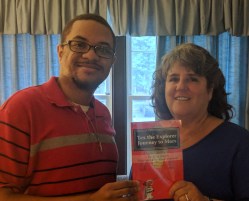
A friend asked for ideas on how to use Tex the Explorer: Journey to Mars in her classroom, and I thought this was a great question!

I came up with two ideas.

First of all, I hope it is a great book to use to support the study of the planets in the primary grades.  All of the information in the book about Mars is factual. (I have space scientists in my family and had all my facts triple checked!)  I have heard from folks who bought the book, that it is a great conversation starter for kids about space.

Another use for the book would be that it was written by a teacher and illustrated by her former student.  Neither of us are professionals, and neither of us has done anything like this before.  I hope it would be an authentic inspiration for students to write their own books about what they are passionate about.  You don’t have to  get your book published and sell it on Amazon for it to be a real book.  With technology today, it is fairly simple to produce a book to share with friends.  Holding a “book fair” to showcase student work would be a great way to present final products.

I would also be honored to communicate with students who are working on writing their own books.  I am happy to email, Skype, or visit in person – if you happen to live in Central Pennsylvania, the DC suburbs, or any place I could use as an excuse for a good trip – Venice would definitely be doable!  If you are in the DC area, I could also see if my illustrator is available.  He is pretty busy with college, but I might be able to get him to join me on a visit.  Again, it’s those interactions with real people that have accomplished real things that make the experience authentic.

*If you use Tex the Explorer: Journey to Mars in your classroom, please let me know how!

Authentic Project Ideas – The Smart Watch

IMG_20180823_091448

With all the fancy Fitbit, Garmin, Google, Amazon, etc., smart watches out there, I thought it might be a cool authentic project for students to design their own devices.

This idea came to me on an airline flight when my husband was obsessing over the fact that his Garmin watch was calculating altitude by air pressure rather than GPS.  As the plane was pressurized (this is a good thing), his watch was reporting altitude by air pressure inside the plane, rather than the altitude the plane was at.  I am sure there are many further examples like this that older students could research, learn about, and maybe even figure out a “fix.”  They could also design their own devices with all the capabilities that they would like.

For younger students this could be more of a fun “imagineering” (thanks Disney for that word) project where they design watches with all of the capabilities that they would want.  They could also research what is available, what they could like to add, and create their dream smart watch. This could also include some authentic practice in telling time.  (Listen for the opportunity and work that skill in.)

*I would like mine to be able to, with the press of a button, bring down the temperature of any room to a lovely 69 degrees!  Oh, and instantly connect to Amazon for shopping. And give me “step” credits for said shopping.  And how about a map directing me to where my favorite television star is hiding (hint – he is Scottish and gorgeous).  And…gosh I may have to do some research and complete this project myself!

Authentic Teaching – Biographies

Scan 18

Almost every curriculum has a grade level objective of writing a biography.  Writing about a famous person is a great objective, as long as the student is really interested in,  and has a connection to, the person they are researching.  If this isn’t present, it is just another exercise where little to no learning will be internalized.

Writing biographies can easily be incorporated into an authentic project.  For the group of students I worked with who did the year long State Fair Project, we had them write a biography about someone famous from their state. (Definition of “from” included –  born there, lived there, worked there, retired there…) Not only did this tap into their interest about the state they “owned” for the year, it also allowed them a great deal of latitude in picking a person who really interested them.  We even managed to find a subject for a young lady who was determined to research and write about a figure skater – and her state was Florida!  (This was a bit of a stretch, but an Olympic Gold Medalist in figure skating from Canada had spent her later years retired in Florida – worked for us!)

The Authentic Experience – Time Zones

chrisjan20131Quilt by Chris Staver

I am passionate about Authentic Teaching and Authentic Experiences, because I believe that is truly the way we internalize learning.  I  just returned from a marvelous trip to Alaska.  I kept a list of entries I wanted to add to my blog when I returned home.  However, yesterday we traveled for 22 hours through four time zones, arriving home at 4AM.  So in order to publish somewhat coherent blogs, they will have to wait for another day or two!

Having completed hundreds of worksheets on calculating time and time zones as a student (and admittedly giving students hundreds to do as well during my early years as a teacher) I can honestly state that nothing compares to the authentic experience of resetting you watch four times, recalculating your departure and arrival times, and trying to drag yourself out of bed the next day suffering from severe jet lag.  I definitely internalized the “time zone” concept!   Bye for now…gotta go take a nap!

*I promise to publish ideas for teaching the concept of time zones in future blogs – once my brain fog clears!

Authentic Project Ideas – The State Fair

Scan 17

I am a huge fan of geography and love authentic projects that teach geography.  I was involved in an extremely successful project where each child picked a state in the United States to study.  Actually, they had to write a letter to the classroom teacher persuading the teacher to let them study the state they were interested in.  To do this they were already researching states for material for their persuasive letters (reading/writing).

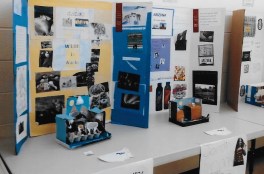
The students then spent the entire school year learning about their state.  We tied the state research into reading, writing, and math.  (I’ll post individual blogs with ideas on how to do this – way too much for one blog!)  At the end of the year we presented what they had learned in a State Fair.

Authentic Project Ideas – Adopting the Elderly

IMG_20180803_201456 (1)

There are many possible authentic projects for students that would like to adopt older folks from an assisted care community or residence.

A few ideas (depending on the number of students involved, these ideas can be for all residents, a few, or even just one):

Get a list of everyone’s birthdays in the residence, chart/graph this and make cards for birthdays.

Create surveys asking residents about favorite things, write stories, poems, etc., based on the results of the survey.

Make cards, ornaments, placemats etc., as gifts for holidays.

Create and send a student generated monthly newsletter, magazine,  or newspaper.  Copy for each resident.

I also found this on Facebook:

The International Card Exchange for the Elderly

It lists homes that are asking for cards.  Listings are international –  a great authentic tie in with geography.  *I am not sure how current this page is, make sure and check out that a listing is current before you have students create cards.

Teachers – Don’t Put Up Those Bulletin Boards Before School Starts!

Scan 9

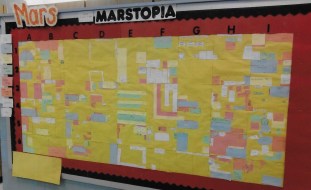
A few years ago, my principal gave me an empty classroom to reverse terraform into a Prototype Martian Colony.  I walked into the empty classroom and as excited as I was, my heart sank when I saw the condition of the classroom (the classroom had been empty for a few years – you can picture what it looked like).

The first thing I decided to deal with was covering the bulletin boards with paper.  After five minutes of staring at the boards (they didn’t appear to be covering themselves), I decided to get the fifth-graders to help me.  School had already started, so I could borrow a few kids from the classroom I co-taught in.  I figured five bulletin boards, at an hour per board, we could easily finish this in less than a day.  The fifth-grade teacher happily lent me a few of her kids.  She actually did a quick authentic math lesson – if there were five boards, and we had twenty-seven kids in the class, how many kids should work on each board?  And how should we handle the two extra students as there was a remainder?  (It is truly amazing how many opportunities there are in a school day that teachers miss for these quick authentic lessons.)  We walked across the hall to the empty classroom and as I started to issue instructions I suddenly realized I also had a golden opportunity here for some authentic teaching and learning.  So I pulled up a chair, sat down, and told the kids to cover the first of the five uncovered boards.

After an hour we had finished covering – nothing!  The kids had absolutely no idea what to do.  Five years of doing hundreds of worksheets on measurement and solving “story problems” and they had no idea how to measure, cut paper, and cover a bulletin board.  I began to give some hints, and retaught how to use a ruler (actually measuring something real – authentic – not a line on a piece of paper).  The kids had discussions about how to measure, what to use to measure (ruler versus yard stick), what side of the ruler/yardstick to use (U.S standard versus metric) what color to use, where to get the paper from, how to ask the media specialist (politely) for access to the bulletin board paper, getting the paper back to the fifth-grade wing without tearing it – the experience moved way beyond simple measurement.

The kids finally covered half the board, and they realized the paper was not wide enough to cover the entire board.  But two pieces were too wide.  What should they do? At the end of the day, one board was covered.  Yes, they had been out of class for a day, but the phenomenal classroom teacher understood the value of authentic learning, and when I returned the first group of students, she gave me five more to work on the second board.  This went faster as there had been some prepping of the second group by the first group on the playground (math language/cooperation/strategy sharing).

What I thought would be a one day task, took a week.  We got those boards covered.  And the one board that had a slight tear in one section we covered with a picture of Marvin the Martian and no one was the wiser.  It turned out this was a strategy the classroom teacher often used when she covered boards and there was a rip, or the paper didn’t line up perfectly.   Great problem solving strategy – and this also became a class inside joke the entire year!

So as I reflected on this, it dawned on me that instead of teachers spending their precious time before the kids come back to school in the fall, covering and creating bulletin boards, let the kids do it.  This is a golden opportunity for the students to engage in an authentic learning activity.  And it also gives them increased ownership of their classroom. (Those fifth-graders had total ownership over the “Martian Colony” classroom, and it started with covering the boards.  And when students “own” something the engagement and learning multiplies exponentially)  Even kindergarten students can help cover bulletin boards.  This does mean that students will return to blank bulletin boards in the fall, but a simple “Under Construction by Students” sign explains the blank boards on opening day.  And I can guarantee this one project will result in students understanding, and internalizing, measurement skills far better than completing hundreds of worksheets!